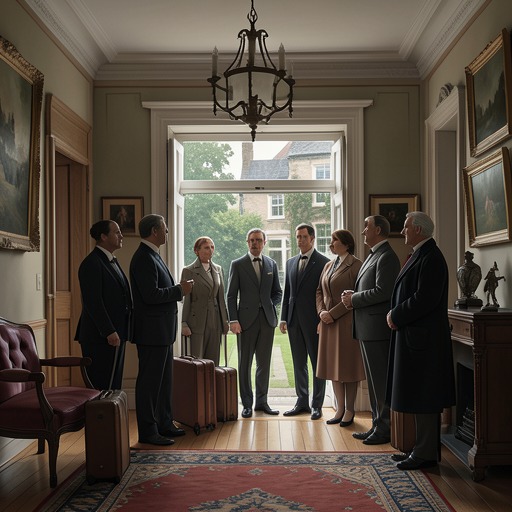
Madame Verdurin
In Search of Lost TimeMadame Verdurin, known to her followers as the Mistress, is a salon hostess whose command of social life rests on a paradox: she insists that her circle is complete in itself, yet continually measures it against the prestige of the world outside. Her Wednesdays are at once cultivated gatherings, instruments of exclusion, and carefully managed steps toward fashionable recognition. At La Raspelière, her maneuvering around the Cambremers and her ease in directing the room reveal how artistic authority, political allegiance, and social ambition can reinforce—and unsettle—one another.
The Mistress and her social stage
Madame Verdurin’s gatherings do not simply assemble guests; they give the faithful a shared calendar and an internal measure of distinction. She calls the dinners Wednesdays, and treats each as a work of art whose success can be ranked against the previous week’s. One Wednesday may have been inferior to the last, while the next is promised as one of the most successful she has ever given. As the Paris season draws to a close, she counts down the remaining Wednesdays in tones of impending catastrophe, then evades the announced finale by declaring that she will be at home on Wednesday after all. Even a supposedly private gathering can become the finest Wednesday of the year. At La Raspelière, where the circle is smaller, almost any day can acquire the name and function of a Wednesday.
This ritual makes attendance a test of fidelity. The Mistress exhorts the regulars not to let her down for the finale, while the repeated promise of an exceptional next gathering keeps them oriented toward her judgment. The group’s identity is not merely a matter of who is present; it is maintained through comparisons, anticipations, and the hostess’s power to declare one evening a triumph and another a disappointment. Her language makes sociability resemble artistic production, with herself as both organizer and critic.
The room’s performances extend beyond the Wednesday dinners. At a gathering where the Cambremers have arrived, Cottard announces their entrance with excitement, but Madame Verdurin refuses to respond as though the news matters. She is speaking with the newly arrived Baron de Charlus and turns the moment instead into an introduction, pointing to him with her fan and presenting him to Cottard as the Baron. The feigned indifference to aristocratic guests and the calculated display of a titled newcomer occur in the same gesture: the Mistress controls not only who enters the room, but how that entrance is understood.
A circle under pressure
At La Raspelière, Madame Verdurin tells her followers that inviting the landlords, the Marquis and Marquise de Cambremer, is an unpleasant obligation imposed by practical considerations: she hopes to secure better terms the following year. Her professed reluctance is not wholly false. She fears that outsiders, unfamiliar with Wagner’s Ring and Meistersinger, will be unable to take part in the conversation and might spoil the Wednesdays, which she imagines as delicate creations vulnerable to a single discordant note. Yet the prospect also enchants her for reasons of snobbery she prefers not to acknowledge. Her anxiety and desire coexist: she defends the little circle’s purity while anticipating the distinction that an aristocratic presence could lend it.
Politics complicates the invitation. The Verdurins’ circle is strongly Dreyfusard, and Madame Verdurin herself sincerely supports Dreyfus. Her husband predicts that the Cambremers will be anti-Dreyfusard and jingoistic, but she claims that the group has heard enough of the Affair. She would, in fact, welcome a social counterweight to the circle’s prevailing Dreyfusism. Figures such as Labori, Reinach, Picquart, and Zola remain suspect to society, keeping the faithful apart from fashionable company; meanwhile, artists associated with the opposing side, including d’Indy and Debussy, offer a possible route back to the topic of art. She proposes setting the political question beside Brichot, the sole regular who has sided with the General Staff, then returns to her stated objection: the Cambremers bore her. Her explanation turns a political divide into a question of salon management, without erasing the actual divisions beneath it.
The tension is part of a broader contest over cultural and social standing. When Cottard arrives at the station with the group, he is exhilarated to have caught the train at the last moment, calling the arrival a success and treating it like a prank. But the passengers’ evening clothes also show that the Verdurins are making tentative moves toward fashionable society, even as they deny the ambition until its objective is achieved. The salon has acquired cultural prestige as a Temple of Music: Vinteuil’s name is celebrated even though his sonata remains little known outside a new interest among young men of the Faubourg. The Princes of Caprarola’s visit to Madame Swann, and her mention of the Verdurins there, indicate that the circle’s name is beginning to travel through elite networks. Odette initially denies knowing them, then regrets the denial and later adopts the pose of someone who had known them all along. The Mistress’s rise is thus registered not only by the people who enter her rooms, but by the unease and revisions her name provokes elsewhere.
Reputation, newspapers, and selective admission
Madame Verdurin’s ascent takes place alongside a pointed distinction between being reported as fashionable and actually possessing social authority. Mme de Saint-Euverte’s salon can look pre-eminent to readers who know society chiefly through party columns in the Gaulois or the Figaro. Its published guest lists name ambassadors and duchesses, but many of those guests have attended only after entreaties and favours, feeling that their presence does the hostess an honour. By contrast, a truly fashionable hostess may invite only two or three duchesses, whom she could easily have assembled in greater numbers, and send no guest list to the newspapers. Publicity can therefore obscure the difference between a gathering sought out by the elite and one attended as a duty.
The same gap between public report and lived access shapes the judgment of parties in general. Before the following day, when the uninvited read that the Prince and Princess de Guermantes have held a large party, a gathering may have little reality beyond the room itself. The social columns can turn an omission into a personal mystery for someone who spoke to the hostess only days before, while the host’s invitations may mobilize people whose existence she had forgotten for years. Social status is therefore not simply announced by a printed list: it is made and remade through invitations, refusals, private loyalties, and the ability to secure admission to the right rooms.
A contrasting strategy appears in Madame Verdurin’s willingness to entertain the unelected separately, away from the most fashionable company. The excluded are offered refreshments and music, but the arrangement releases the hostess from inviting them alongside the best people. The older Marquise de Cambremer and an architect’s wife with a fine voice are among those left out of the changed Saint-Euverte circle; feeling stranded among guests they scarcely know, they are not invited the following year. Madame Verdurin’s own circle has its rituals of fidelity, but its rise takes place within a social world that continually sorts people into insiders, tolerable company, and those quietly left behind.
Hospitality, rank, and the choreography of power
The novel repeatedly makes hospitality legible through small acts of service and courtesy. When the Princesse de Parme leaves dinner at the Balbec hotel, she tips Aimé, the wine waiter, and the lift-boy, accompanying the gifts with friendly words and smiles. Her spontaneous manner makes her seem, to people who do not know her identity, like a regular visitor of modest origins. The scene turns on the distance between rank and its appearance: her conduct expresses a sovereign’s sense that she is at home wherever she goes, while those observing her misread the same gestures through ordinary social categories.
At the dinner with the Cambremers, the Baron de Charlus makes a different use of courtesy. When M. de Cambremer seems about to rise and offer him his chair, Charlus treats the offer as recognition of an obligation owed to a prince, although the Marquis may have intended nothing more than politeness. Charlus declines with a vehement protest, pressing both hands down on Cambremer’s shoulders and insisting that such precedence is reserved for Princes of the Blood. He then explains the precedence claimed by his family, recalling disputes at court over who might kneel on a hassock, who entered before the King, and whose ushers could carry raised batons. Rank is presented as an inherited right, but its force has to be asserted in the immediate encounter, through gesture, speech, and the interpretation of another person’s movement.
Madame Verdurin’s own authority is less a matter of inherited precedence than of orchestration. She can make an arrival appear unimportant, turn it into a formal introduction, or draw a useful guest into the circle without surrendering control of the room. That skill places her alongside the other hosts and high-ranking figures whose etiquette makes power visible. Where Charlus invokes generations of family history and the Princesse de Parme embodies royal self-possession, Madame Verdurin establishes her position by managing attendance and assigning meaning to each social encounter.
Cultural authority and personal change
Madame Verdurin’s relation to art is bound up with the history of her friendships. She has lived long enough to see her own expression change under the music she once affected to admire. In the days when Charles Swann and Odette listened to the little phrase at her house, she had to assume an air of exhausted aesthetic rapture. Later, the headaches associated with Bach, Wagner, Vinteuil, and Debussy have left her forehead enlarged and her face permanently marked by the strain of listening. She no longer needs to perform the extreme impressions one by one: resignation to the suffering of beauty has become her habitual expression. Even the effort of dressing for dinner after a recent sonata, and the need to hide to take two spoonfuls of aspirin, belong to this altered image of the hostess who makes artistic endurance part of her social identity.
The portrait complicates the opposition between genuine taste and mere display. Madame Verdurin’s response to music has become a role so habitual that it no longer needs to be consciously enacted, yet her salon also helps give artists and works a public life. The social prestige of Vinteuil’s name grows through cultural intermediaries, and the Mistress’s gatherings provide the setting in which artistic reputation can be cultivated and circulated. Her authority does not depend on being a disinterested judge outside society; it operates through the very acts of gathering, listening, praising, and excluding that shape the group.
Her position also depends on relationships that can be generous and exploitative at once. She once helped Brichot by removing his laundress from his life when she found the woman occupying his rooms, and he never forgot what he regarded as a rescue. His closeness to the Verdurins lends him glamour among his Sorbonne colleagues: they are dazzled by his accounts of dinners they will never attend, by his appearances in reviews, and by his cultivated dress. Yet Madame Verdurin begins to tire of this follower precisely because his obedience is so assured. She can value his attachment while finding it less stimulating than the distinction it once conferred.
The same impatience governs her response to Saniette. When challenged over her unkindness, she says that he adores the group and needs its dinners, but argues that his dependence does not excuse his submissiveness. If M. Verdurin is irritated by Saniette’s stupidity, she says, Saniette ought to answer back rather than cringe like a whipped dog. She insists that she tries to restrain her husband because Saniette might stop coming and needs the meals, yet also maintains that he may stay away if he takes offence. Her account exposes the moral cost of the circle’s hospitality: dinner can be support, but the guest who depends on it may be expected to endure humiliation and prove his worth by remaining.
Madame Verdurin’s narrative importance lies in this ability to make a salon feel at once intimate and competitive. Her Wednesdays promise refuge in a chosen community, but that refuge depends on continual distinctions between the faithful and outsiders, artists and bores, the invited and the omitted. As the circle gains cultural and social recognition, she does not simply abandon its exclusions; she adapts them, negotiating between the purity of the little group and the attractions of aristocratic company. The Mistress’s power is the power to stage belonging—and to make the staging itself seem like taste.